



Prof. Mehmet Efe Çaman
The Gülen movement is one of the two marginalized groups together with Kurds in present-day Turkey. However, the situation was quite different ten years ago. Those who launched a fierce campaign to “finish off” the Gülen group in today’s Turkey once deemed it their closest ally.
The politicians who currently rule the country used to send their own kids to schools run by the movement. They were subscribers of Zaman daily. They often appeared on Gülen-affiliated TV channels, calling Fethullah Gülen “Hocaefendi” – a title that his followers call him with reverence.
Whenever someone criticized Gülen, the same politicians rushed to denounce those critics even before his followers. These politicians issued commemorative coins for the Turkish Olympiads, a series of annual cultural events the Gülen movement had been organizing. President Recep Tayyip Erdoğan gave a speech to the thousands of attendants during one of these events and invited Gülen back to Turkey after he expressed his “longing” in the “tribune” of an Istanbul stadium in June 2012.
The Gülen movement supported the ruling Justice and Development Party (AKP) for a long time. To tag along after a political party for the movement which had never engaged with any political parties could sound hollow. But it’s not fair to ignore the irreconcilable differences between AKP’s discourse, political goals and practice in its first decade, namely the 2001-2011 period, and the same party’s discourse and actions today.
Back then, AKP used to be a reformist political party striving to accomplish the European Union reforms in its first years; the party seemed to embrace the liberal democracy and uphold the rule of law. Not only the Gülen movement but also liberals, Kurds, minorities, leftists, and pro-EU circles supported the AKP in those years. On the other hand, some of the other political parties were dragging their heels when it came to incorporating EU reforms within the same period.
For instance, nationalists in Republican Peoples’ Party (CHP) regarded EU reforms aiming to improve the country’s institutional democracy as concessions given to the West. Therefore, CHP never supported the AKP in its steps to realize reforms. Likewise, the Nationalist Movement Party (MHP) detested the EU reforms. MHP opposed to the progressive agenda – particularly the one intending to resolve the Kurdish issue politically rather than militarily – just as the nationalists in the CHP did.
Peoples’ Democratic Party (HDP) and Kurdish political circles were glad about the AKP’s pro-EU political stance. A positive step to a direct dialogue between the Turkish state and the insurgent Kurdistan Workers’ Party (PKK) gratified the Kurdish politicians. They saw the move as the most critical opportunity in Turkey’s history to solve the Kurdish issue. In brief, blaming the Gülen movement for supporting the AKP, thus paving the way for today’s AKP regime is manifestly ill-founded and unfair.
AKP considered the Gülen movement in those years a fairly legitimate element of Turkey’s civil society. On the other hand, the Gülen movement regarded the AKP as a genuinely democratic, favorable political party. These approaches set a natural cooperation plane.
ZAMAN DAILY BROKE THE MEDIA MONOPOLY
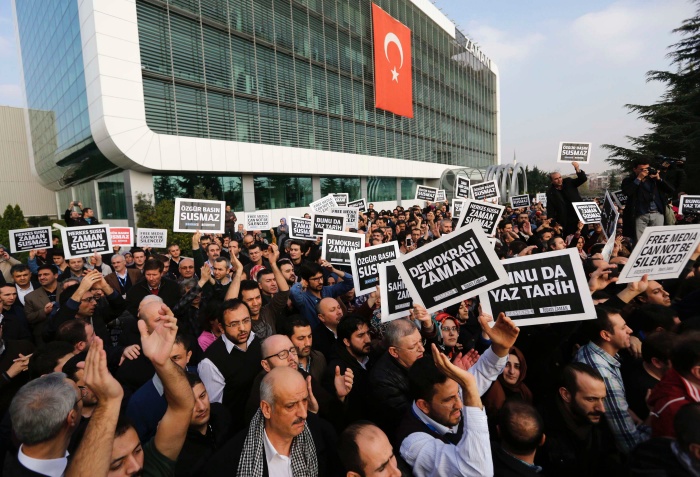
The Gülen movement had a certain influence on Turkish politics between 2002 and 2011 which came true with the help of the group’s human source/potential, and its power in the media sector. As a civil society movement with its primary focus on education, the movement gave weight to establishing schools, procuring scholarships to high-flyer students, and founding universities.
Its power in the media came into effect as its several media outlets, including Zaman daily, offered an alternative to the settled secular/Kemalist elite media. There used to be a lack of alternatives in the Turkish media landscape due to that Kemalist monopoly, and Zaman broke the ice of that solo trade. The Zaman not only opened its doors to the writers from the movement but also the liberal-democrat columnists. This unique selling proposition ensured that Zaman daily’s audience was as diverse as it gets. Apart from the followers of the movement, the newspaper attracted readers from other religious and liberal groups.
Between 2002 and 2011, the primary motivation shared by both the AKP and the Gülen movement was to make Turkey a democratic country. Both the AKP and the Gülen movement had a high opinion of ending the military-bureaucratic veto regime that presided over the country since its foundation and upholding the rule of law based on EU-style liberal democratic principles. In fact, the closest the country ever approached to a functioning liberal democracy was without any doubt the time period between 2002 and 2011.
It would not be wrong to claim that the modern political history of Turkey is a history of corrupted, partisan spoils system. AKP has also struggled to set up its cadre in public offices, which is not odd. All ruling parties in Turkey have struggled to set up their own cadres in bureaucracy. For many, “getting in the body” of this giant and powerful “Leviathan” was the only way to avoid the Turkish state’s wrath. This understanding is the core of the political fight in Turkey’s history.
While the AKP started employing people close to its Islamist ideology, it also embraced the seasoned human source of the Gülen movement, considering the group “on the same page” with them and sharing a similar world view. As a matter of fact, the Gülen movement had much more qualified human sources than the other religious or Islamist groups. Verily, even if the AKP did not prioritize the Gülen followers in public sphere, the percentage of public officers close to the movement increased in years anyway.
THE GÜLEN MOVEMENT DID NOT INFILTRATE THE STATE
The Gülen group did not infiltrate the bureaucracy but participated in it. If there is to be a “responsible,” then it is the AKP government that made the political choice to hire the movement’s followers. Besides, it’s relevant to highlight that employment requirements in the state are designated in the law. And the government is full responsible for the hiring process in bureaucracy and public sector. Accordingly, as the constitutional order determines like in any other democratic country, any citizen regardless of her or his personal world view can become a civil servant in Turkey. A discrimination regarding non-objective criteria cannot be done.
What is important is whether a person is qualified according to objective job requirements or not. AKP has been the sole decision-maker for years. If there was any irregularity during the hiring of skilled employees, the responsibility is with AKP. AKP should have presented objective evidence and started an investigation regarding any alleged extralegal practice during the hiring processes in Turkish public sector for which it was constitutionally responsible.
It’s unacceptable to persecute a whole group based on the unfounded allegations nourished by persisting bias. However, this is what we witness happening in Turkey today. The allegations about the movement that it “stole” the questions of some centrally-run entrance exams to register in a university or hold public positions are widely accepted in Turkish society, whereas claimants are yet to put the evidence on the table to back these allegations. Numerous people have been labeled and dismissed so far from their posts with presidential decrees over baseless allegations.
For sure, prosecutors should investigate the claim that “The Gülenists stole the exam questions.” But they must set forth with evidence if a crime was committed, and if it was so who committed it, and whether or not it was an organized or personal misconduct. However, we have a “small problem” in that context: today’s Turkey, where the judiciary is de facto entirely under the government’s control, and the constitutional order is not abided by, doesn’t enable a fair and lawful investigation. The vey biased and widely-accepted discourse claims that all “Gülenists in public service” acquired their posts by “stealing the questions”.
This conviction without any evidence and a trial cannot be questioned today, since everybody who criticizes it is labeled as “Gülenist” and purged. Ankara’s mass crackdown on the alleged followers or supporters of the Gülen movement includes dismissing and terrorizing hundreds of thousands of people without evidence of a crime. People are simply persecuted and are expected to “prove their innocence” like in the Third Reich Gestapo procedures.
CLAIMS OF CONSPIRACY AGAINST THE MILITARY

Some circles in Turkey claim that the Gülen movement conspired against the Turkish military by masterminding corrupted investigations such as Ergenekon, Balyoz (Sledgehammer), Sarikiz, and Military Espionage cases. They claim that the criminal investigations in these cases and court processes were fabricated plots to topple the then-Prime Minister Erdoğan. Those circles deliberately overlook that these cases were based on serious evidence, including voice records of military meetings and official documents. They manipulate the public by purpose through massive propaganda and to make people forget about Erdoğan’s and his cabinet’s open support to those legal cases. They attempt to artificially correlate lawsuits against the alleged coup plotters and corruption cases of December 17, 2013, which came up with massive corruption and money-laundering allegations against AKP ministers and Erdoğan’s inner circle.
The conspiracy theory of the Turkish government which has become the mainstream perception in Turkey claims that the Gülen movement was the mastermind all of those cases. However, there are some basic questions to be asked to understand what happened in those legal investigations.
1- How can anyone hide the concrete shreds of evidence in Ergenekon cases?
2- How can anyone ignore the concrete shreds of evidence in corruption investigations targeting the AKP officials?
In a bid to whitewash the existing evidences against them in Ergenekon cases and 17 December 2013 corruption cases, the government and the suspected individuals and groups assert that Gülen Movement launched those investigations and it was as set-up. Their co-operation against and targeting the Gülen movement as a scapegoat is based on their common interest to hide the ugly truth.
WHAT IS TERRORISM? WHO IS A TERRORIST?
AKP claims that the Gülen movement is a terrorist organization. Calling dissidents as “terrorists” and cracking down everybody who disagrees with them is widespread in authoritarian or semi-authoritarian regimes. The fact, in a rule of law non-violent groups cannot be accused of being terrorists, as resorting or complimenting violence is the essence decomposition point of separating a terrorism act/group from the others.
AKP blames the Gülen movement for instigating the July 2016 abortive coup. But the Turkish government still has not been able to prove the affiliation of the soldiers involved in the coup with the Gülen movement. It has not been able to manifest whether any soldier received instructions from the movement. Moreover, it’s unclear whether what the coup of July 15 2016 was a real military coup or a government-controlled staging. No members or followers of the Gülen movement were involved in any violent act even after hundreds of thousands of them have been detained, arrested, and dismissed from their jobs so far. Uncountable criminal investigations have never found a weapon or material to use as a weapon during the house raids to the group’s alleged members. Is the Turkish government seriously expecting that the whole world is supposed to believe there are (imaginary) “terrorists without weapons” because it just wants so?
‘FETO’ ACRONYM IS CONJURED UP TO REINFORCE WITCH-HUNT
There is no evidence showing the Gülen movement is an organized crime group or a terrorist one. The movement is a scapegoat in today’s Turkey, pointed as a target both by the state (regime) and opposition.
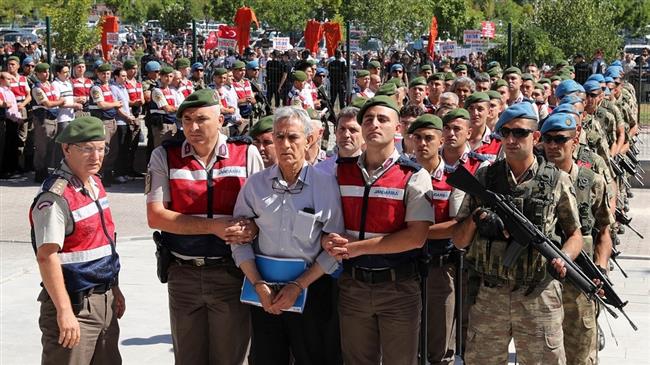
Grassroots of AKP, MHP, CHP, IYIP, and partly HDP support this idea. AKP hates the movement for two reasons and wants to suppress it. 1- Erdogan laid the responsibility of corruption investigation against himself and his party at the Gülen movement’s door. 2- AKP saw the movement as a rival. Nationalist MHP hates the movement due to the Gülenists’ pro-EU and pro-West position. Secular CHP’s nationalist/Kemalist base hates the Gülen movement over their bias against all Islamist of non-secular groups and considers it a radical, fundamentalist, and anti-Ataturk religious sect. CHP accuse the Gülen movement of masterminding the coup-plotting cases such as Ergenekon, Sledgehammer, and Sarikiz. Pro-Kurdish HDP doesn’t want to be entirely excluded from the “state” and uses the anti-Gülenist discourse from time to time. And the Gülen movement’s cultural Turkish nationalist stance in the past disturbs the supporters of the HDP.
No doubt the Gülen movement should evaluate its positions in the past under the light of allegations about itself and initiate purification. The mass punishing and unlawful prosecution it faces, on the other hand, are violations of the fundamental rights. It’s time for all social factions in Turkey to question human rights violations and the discrimination and persecution the Gülen movement faces.
The post [OPINION] Demonization of the Gülen movement unfair and baseless appeared first on Turkish Minute.
from Turkish Minute https://www.turkishminute.com/2020/08/26/opinion-demonization-of-the-gulen-movement-unfair-and-baseless/

Hiç yorum yok:
Yorum Gönder